Multi-axis
The Multi-axis tab generates secondary axis funscripts — roll, pitch, twist, surge, and sway — from your primary stroke data. You assign a position style to each phrase, and FunscriptForge derives the secondary axes algorithmically at export time. No video analysis, no GPU, no hand-scripting.
The result: your single-axis funscript becomes a full multi-axis experience for OSR2 and SR6 users. Every phrase can have its own physical position style, so the secondary axes change character across the scene arc — just like the real thing.
The six axes
Funscripts use the T-Code convention for naming axes. Your primary funscript is always L0 (stroke). The Multi-axis tab generates the other five:
| Axis | Code | Motion | File | Devices |
|---|---|---|---|---|
| Stroke | L0 | Up/down | {stem}.funscript |
All |
| Surge | L1 | Forward/back | {stem}.surge.funscript |
SR6 |
| Sway | L2 | Left/right | {stem}.sway.funscript |
SR6 |
| Twist | R0 | Rotation | {stem}.twist.funscript |
OSR2+, SR6 |
| Roll | R1 | Tilt left/right | {stem}.roll.funscript |
OSR2, OSR2+, SR6 |
| Pitch | R2 | Tilt forward/back | {stem}.pitch.funscript |
OSR2, OSR2+, SR6 |
FunscriptForge generates all axes that the assigned styles use. Devices ignore the files for axes they don't support. T-Code players (MultiFunPlayer, XTP) auto-discover files by the .axis.funscript naming convention — no configuration needed.
How it works
- Load a funscript and walk through at least Device and Tone so phrases are detected.
- Open the Multi-axis tab. Your funscript is shown at the top with phrase labels (P1, P2, ...) as a visual reference.
- Assign a position style to each phrase using the dropdown in the table. Each style simulates a different physical position by deriving the secondary axes differently from the stroke data.
- Preview to see monochrome charts of each generated axis. The charts show the full script with active and neutral regions clearly visible at phrase boundaries.
- Accept to save your assignments. The actual funscript files are generated at Export time, not here — Accept just saves the decisions.
- Export with a mechanical device selected. The
mechanical/subfolder will contain the primary funscript plus one.axis.funscriptper active secondary axis.
Position styles
Five presets are available. Each one maps the secondary axes to algorithms that derive motion from your L0 stroke data.
Which axes does each style use?
| Style | Roll (R1) | Pitch (R2) | Twist (R0) | Surge (L1) | Sway (L2) |
|---|---|---|---|---|---|
| Cowgirl | Gentle sway | Follows stroke | Slight random | — | — |
| Missionary | Stroke-speed driven | Gentle sine | — | — | — |
| Doggy | — | Strong forward thrust | — | — | — |
| Riding | Wide sway | Anti-correlated | Random walk | Slow drift | Slow drift |
| Random | Random walk | Random walk | Random walk | Random walk | Random walk |
Surge and sway (L1, L2) are translational movements that only the SR6 supports. The simpler styles (Cowgirl, Missionary, Doggy) stick to rotational axes that work on all multi-axis devices. Riding and Random go full SR6.
Style descriptions
Cowgirl — Rocking motion. Pitch follows the stroke direction (forward on up-stroke, back on down-stroke). Roll is a gentle left-right sway whose amplitude grows with stroke speed. Twist is a subtle random walk for variety.
Missionary — Side-to-side emphasis. Roll is dominant, driven by stroke velocity — fast strokes create pronounced side-to-side tilt. Pitch is a gentle sine wave. No twist.
Doggy — Forward-thrust emphasis. Pitch is the only active axis, strongly correlated with stroke and biased forward. The device tilts forward on every stroke. Minimal other motion.
Riding — Full circular motion. All five secondary axes are active. Roll and pitch work together with wide amplitude. Twist is a random walk. Surge and sway add slow translational drift. This is the "everything moves" style — most immersive on an SR6.
Random — All axes get independent random walks, amplitude modulated by stroke velocity. Fast sections get more motion; slow sections stay calm. The "surprise me" option. Good for content where you don't know what position fits.
Per-phrase assignment
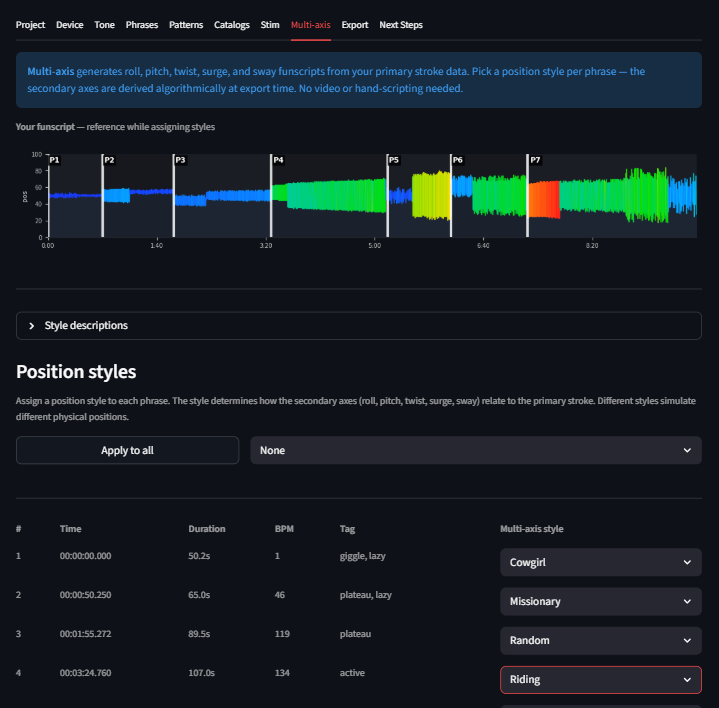 Assign a position style per phrase. Each style generates different secondary axis motion.
The table shows every phrase with its time, duration, BPM, and behavioral tag. The Multi-axis style dropdown lets you pick a different style per phrase.
This is powerful because real scenes change position. A funscript that starts gentle and builds to intense benefits from different secondary axes in each phase:
| Phrase | Character | Suggested style | Why |
|---|---|---|---|
| Slow build | Low BPM, wide amplitude | Cowgirl | Gentle rocking that builds |
| Steady rhythm | Medium BPM | Missionary | Side-to-side adds variety to a steady stroke |
| Transition | Low activity | None | Let the device rest — contrast makes the next style hit harder |
| Intense | High BPM, full range | Riding or Random | Full motion for the peak |
| Cooldown | Slowing down | Cowgirl or None | Wind down gracefully |
Apply to all sets every phrase to the same style. Use this when you want a uniform feel, or as a starting point before customizing individual phrases.
None means no secondary axes for that phrase. The device stays centered on all non-stroke axes during that phrase. Use None for transitions, quiet moments, or phrases where the primary stroke is enough.
Preview
Click Preview after assigning styles to see monochrome charts of each generated axis:
- L0 Stroke (input) — your primary funscript, full width
- Secondary axes — shown 3-across below the stroke. Each chart shows the derived motion for that axis across the full script duration.
Active phrases show motion; None phrases show flat lines at the neutral position (50). Phrase boundaries are visible as transitions between active and flat regions — a raised-cosine crossfade smooths the transitions so the device doesn't jump.
The preview is generated in memory and doesn't write any files. It's fast — typically under a second for a 90-minute funscript.
What gets exported
When you click Export All with a mechanical device selected and multi-axis styles assigned, the mechanical/ subfolder contains:
mechanical/
  {stem}.funscript              ← L0 stroke (always present)
  {stem}.roll.funscript         ← R1 (if any style uses roll)
  {stem}.pitch.funscript        ← R2 (if any style uses pitch)
  {stem}.twist.funscript        ← R0 (if any style uses twist)
  {stem}.surge.funscript        ← L1 (if any style uses surge)
  {stem}.sway.funscript         ← L2 (if any style uses sway)
Only axes that at least one phrase uses are written. If no phrase uses twist, no .twist.funscript is generated.
To play: load the mechanical/ folder in MultiFunPlayer, XTP, or any T-Code player. The player auto-discovers all axis files by filename convention.
Deterministic output
The generation is deterministic. The same funscript with the same style assignments always produces the exact same multi-axis output. Random-walk algorithms use per-phrase seeds derived from the phrase index and axis name, not from system time. This means:
- Re-exporting produces identical files
- Sharing a
.forgetmpltemplate with someone else and applying it to the same funscript produces the same result - You can trust the preview — what you see is what you get
What this is NOT
- Not a manual multi-axis editor. FunscriptForge generates secondary axes from presets. If you need hand-placed keyframes on specific axes, use OpenFunscripter.
- Not AI video tracking. FunscriptForge derives from the L0 stroke data, not from video. For video-based multi-axis generation, see FunGen.
- Not real-time playback. Files are generated at export time. MultiFunPlayer handles playback.
FunscriptForge is the fastest path from a single-axis funscript to a multi-axis experience. For most scripts, the preset styles produce results that feel authored, not random — because they're phrase-aware and derived from the actual stroke data.
Related
- Export → — where multi-axis files are written to the mechanical/ subfolder
- Device tab — select your mechanical device targets
- Stim tab — estim channel generation (separate from multi-axis)
- Device Limits → — axis support per device